
June 2026
Introduction: VMOA Training Excellence
At StratoVox, we specialize in providing high-quality training designed to prepare individuals for successful careers as Virtual Medical Office Assistants (VMOA) in North American clinics. Our courses are thoughtfully developed to equip learners with the essential knowledge, practical skills, cultural insights, and industry standards needed to confidently support North American healthcare professionals in a virtual environment.
Program Pillars
Our training program is based on three pillars:
- Healthcare system & patient care fluency
- Practical service excellence
- Future-readiness
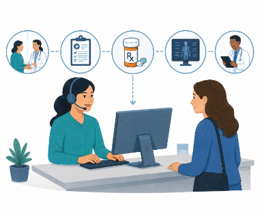
Healthcare system & patient care fluency focuses on equipping VMOAs with a clear, practical understanding of the healthcare environment they support. Trainees learn how the Canadian and US healthcare systems function, how patients navigate them, and how different providers, services, and processes — such as referrals, prescriptions, and diagnostic care — fit together. Just as importantly, this pillar builds understanding of confidentiality, consent, and communication standards to align operations with healthcare regulatory requirements, including compliance with HIPAA, PIPEDA, and other jurisdictional privacy rules. This ensures that VMOAs can handle sensitive information responsibly while accurately guiding patients and supporting clinic operations.
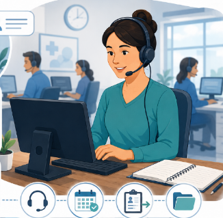
Practical service excellence centers on building the real-world skills agents need to perform effectively from day one. The program emphasizes structured call handling, accurate notetaking, patient communication, and consistent execution of clinic workflows such as appointments, referrals, and record management. By combining service mindset development with hands-on use of tools, protocols, and technology, this pillar ensures agents can deliver efficient, professional, and patient-centered support within fast-paced medical office environments.

Future-readiness means preparing agents to adapt to the evolving demands of modern healthcare administration. Beyond current workflows, the program emphasizes continuous learning, technological fluency, and the ability to work alongside emerging tools such as advanced communication platforms and AI-driven processes. By strengthening problem-solving, efficiency, and innovation mindsets, this pillar ensures agents can grow into more specialized roles, support process improvements, and contribute to increasingly digital, scalable clinic operations.
Through our comprehensive training and certification program, we prepare highly skilled professionals who can seamlessly integrate into workflows, support clinics from day one, and adapt to evolving technologies and future healthcare demands.
Content basis of the program
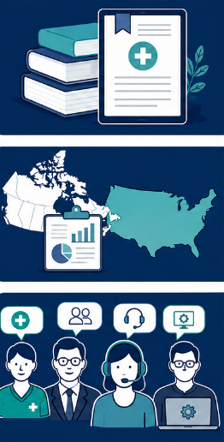
The program is built on a carefully curated foundation that combines academic medical administration resources, healthcare policy research, and real-world insights from industry experts to ensure both relevance and practical application.
- Curated reference materials that are used in top Ontario colleges for medical administration.
- Public healthcare policy research for Ontario, as well as other Canadian provinces and U.S. states.
- Consultations with healthcare providers, healthcare administration professionals, call centre training specialists, and IT experts.
Advantages of our program
Our program is designed to deliver practical, relevant, and future-focused training to prepare high-performing medical office assistants.
Standard college programs in medical administration
- Designed for on-site receptionists.
- Assume familiarity with the Canadian/US healthcare systems, cultural norms, and service standards.
- Excessive on theory – highly time-consuming, but ultimately not used in administration.
- Lack practical skills training – assume that graduates will receive additional training in call handling, customer service, security compliance, and other essential communication and operational skills.
- Largely outdated – uninformed of current technological advances, challenges, and security standards in the healthcare space.
- Are costly and typically require at least 18-24 months to complete.
Our program
- Tailored for remote medical office assistants, not limited to on-site roles.
- Builds foundational understanding of the Canadian and US healthcare systems, cultural context, and service expectations from the ground up.
- Focused on practical, job-relevant training – efficient and directly applicable to real administrative workflows.
- Integrates hands-on skills training in call handling, patient communication, security compliance, and clinic operation.
- Continuously updated to reflect current technologies, workflows, and security standards in modern healthcare environments.
- Accelerated onboarding with continuous development, enabling agents to become job-ready quickly while progressively building advanced and specialized skills as they gain experience in real clinic environments.
Beyond developing knowledge and technical skills, a core objective of the program is to cultivate a strong patient service mindset. Throughout the program, trainees are encouraged to act with compassion, take ownership of their role, and recognize the meaningful impact they have on patient care and clinic operations.
Online Course Curriculum
Online courses are a key part of our training program and go hand-in-hand with our practical on-the-job training. The core objective of these courses is to extend knowledge and increase operational readiness within the healthcare domain, while streamlining workflows and ensuring alignment with regulatory standards in healthcare.
Healthcare systems and clinical domain knowledge
1. Canadian Healthcare System
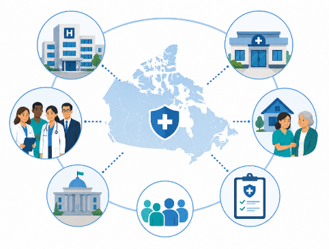
This course provides an overview of the Canadian healthcare system, including how it operates, key stakeholders, and modes of healthcare delivery across hospitals, clinics, and community care. It also prepares Virtual Medical Office Assistants to understand their role within the system, enabling them to effectively support clinic operations and patient care.
Key topics: services covered under the Canadian Health Act, levels of healthcare delivery, family medicine, specialist referral process, prescriptions, requisitions for medical tests, public health, and current system challenges and sustainability.
2. United States Healthcare System
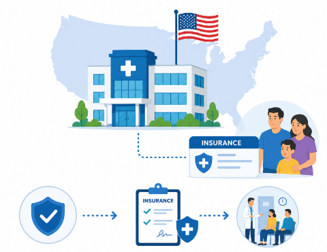
This course provides a comprehensive introduction to the United States healthcare system, offering clear insight into how it compares to the Canadian healthcare system. VMOA will explore the structure and function of healthcare delivery in the U.S., including the role of insurance companies and the factors that influence access to care.
Key topics: structure of the US healthcare system, healthcare financing and payment models, Medicare, Medicaid, Affordable Care Act, healthcare delivery settings, emerging operational models such as value-based care.
3. Introduction to medical reception
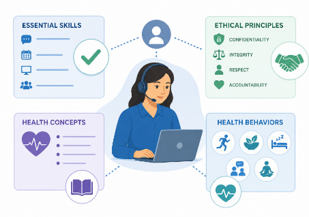
This course provides a clear understanding of the VMOA role and how it differs from other types of remote assistants. The course reviews essential skills for agents, ethical principles that are important for the role, as well as different health concepts and behaviors that are encountered in everyday work.
Key topics: Important competencies and personal attributes of medical administrators, ethical principles, confidentiality and disclosures, health concepts and behaviors.
4. Introduction to disease
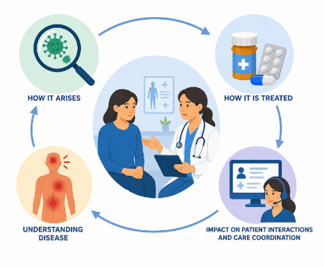
This course builds an understanding of disease, how it arises, how it is treated, and implications for care. Through this course, the learners are introduced to common diseases in North America and how illness impacts patient interactions and care coordination. A key objective of the course is to ensure that VMOAs are equipped to recognize common terminology pertaining to disease and accurately communicate and document information using appropriate medical language.
Key topics: determinants of health, pathogenesis, medical skills, mechanisms of disease, seasonal afflictions, diabetes and obesity, addiction and mental health.
5. Pharmacology for the medical office
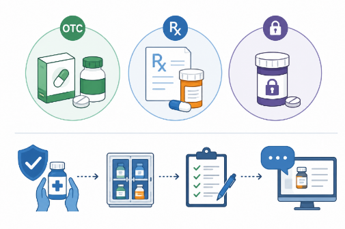
VMOAs will develop a clear understanding of key pharmacological terminology, recognize time-based drug concepts, and distinguish between over-the-counter, prescription, and controlled substances. They will gain practical knowledge of safe medication handling, storage, and documentation, as well as the ability to accurately interpret and communicate medication-related information (without providing medical advice). Designed as a practical introduction to essential pharmacology, this course equips participants with the foundational skills needed to support safe, accurate, and effective administrative work involving medications.
Key topics: drug administration, measurement, abbreviations, documentation, effects of drugs, medication handling and storage, regulatory considerations for medication in the medical office, pharmacology in medical administration.
6. Medical terminology
This course provides participants with a comprehensive collection of essential medical terminology and abbreviations required for their work. All materials are available for download, allowing VMOA to easily reference and revisit the content whenever needed, supporting ongoing learning and practical application.
Key topics: office terms, insurance terms, conditions and symptoms, tests, procedures, medication, vaccines, abbreviations.
Privacy, confidentiality, data handling regulations and compliance
1. PIPEDA – Canadian privacy law
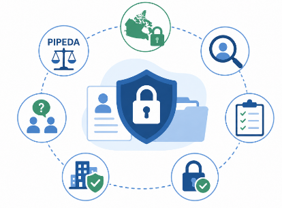
This course introduces participants to Canada’s Personal Information Protection and Electronic Documents Act (PIPEDA) and its application in the workplace. Participants will learn to identify personal information, understand their responsibilities when handling data, and apply key privacy principles in everyday scenarios. The course also covers best practices for safeguarding sensitive information, responding to privacy concerns, and supporting organizational compliance.
2. HIPAA – US privacy law
This HIPAA compliance course provides participants with a clear understanding of their responsibilities in protecting patient health information, focusing on the core principles of privacy, security, and confidentiality. By the end of the course, participants will be able to identify protected health information (PHI), understand their obligations under HIPAA, and apply regulations to safeguard sensitive data. They will also learn how to handle information securely, respond to potential breaches, and follow proper communication and documentation procedures in their roles.
3. Age and confidentiality in healthcare
This is a series of courses that introduces participants to confidentiality practices specific to key jurisdictions in Canada and in the United States. Participants will learn about key legal frameworks that protect confidentiality, the age of majority, and specific situations where exceptions may apply. These courses equip participants with the knowledge needed to manage sensitive information responsibly within their assigned jurisdiction, including the protections established under both federal and state/provincial law.
Jurisdictions are consistently added and updated. They currently include:
- Ontario, Canada
- Manitoba, Canada
- New York State, USA
- Florida State, USA
- Texas, USA
Ethics and professional skills
1. Ethics in medical administration
This course introduces participants to the key principles that guide safe, respectful, and trustworthy administrative practices in healthcare. Participants will learn how concepts such as beneficence, non-maleficence, justice, autonomy, and fidelity apply to daily tasks, including communication and documentation. The course also equips participants to recognize patient vulnerability, manage risks, and apply compassionate, professional, and confidential practices to support patient safety and build trust.
Key topics: ethical principles, vulnerability in medical settings, risk matrices for medical administration, reducing patient risks.
2. Call handling
Proper call etiquette and a structured call flow are essential for maintaining regulatory compliance and ensuring high-quality service. This course helps VMOAs understand professional communication in a medical setting, including how it differs from other industries. They will learn to follow effective call structures, maintain accurate documentation, and efficiently action tasks.
Key topics: etiquette rules, call structure, identity verification, gathering information, actioning calls, note-taking, developing good call habits, back-end tasks and team communication.
3. Skill building: active listening for the medical office
This course is comprised of several skill-building modules designed to help learners develop active listening and comprehension skills. It is designed to train the learner to understand the reasons for (sometimes complicated, wordy, or emotional) calls, and listening for specific details of a call, such as names and phone numbers. These activities are aimed to help VMOAs better understand the patients’ needs, as well as improve call flow efficiency, and reduce errors.
Practical job training
Alongside the online courses, incoming VMOAs participate in fully supervised practical job training, where they shadow senior VMOAs as they support real medical clinics. They get practical experience performing administrative tasks and interacting with patients and the administrative team.
As part of the training, the trainees:
- Learn to work with clinic protocols for appointment setting and other aspects of administration
- Learn how to work with EMRs, communication and reporting tools, and other required software
- Learn front-office and back-office workflows in the medical space
- Develop situational awareness, recognize common errors, and develop foresight of potential risks
- Practice performing administrative tasks (e.g. processing voicemail, forms, faxes, etc.)
- Practice customer service and call handling skills
- Practice notetaking and reporting skills
By the end of the training, VMOAs are able to orient themselves as part of the Canadian/US healthcare system, and are prepared to handle and action common administrative calls and tasks in a medical office setting.